
Asphalt repair is the process of fixing damaged pavement through methods like crack filling, pothole patching, and surface treatments rather than replacing the whole surface. The right method depends on the type and extent of the damage — small cracks get sealed, potholes get patched, and widespread base failure usually calls for replacement. Most asphalt repairs cost far less than replacement, which is why catching damage early matters.
What Is Asphalt Repair?
Asphalt repair is the process of restoring damaged pavement by treating specific problem areas — sealing cracks, patching potholes, or overlaying worn sections — instead of tearing out and rebuilding the entire surface. It’s a spectrum, ranging from a simple crack fill that takes minutes to a full-depth patch that rebuilds a failed section down to the base.
The goal of any repair is to stop damage from spreading before it compromises the pavement structure. Nearly every asphalt failure starts small and gets worse when water reaches the base, so timely repair is what separates a minor maintenance item from an expensive reconstruction.
What Are the Common Types of Asphalt Damage?
Asphalt fails in a handful of recognizable ways, and identifying which one you’re dealing with points to the right repair. The five most common types of asphalt damage are cracks, potholes, depressions, raveling, and upheaval.
Cracks
The most common form of damage, ranging from harmless hairline cracks to structural failures. Cracks let water into the base, which is how most other damage begins.
Potholes
Bowl-shaped holes that form when water undermines the base and traffic collapses the weakened surface. They worsen quickly and pose a trip and vehicle hazard.
Depressions and Rutting
Low spots and channeled grooves where the surface has sunk under concentrated or repeated loads. They collect water, which accelerates further damage.
Raveling
The surface breaking apart as the binder loses its grip on the aggregate, leaving a rough, loose, gravelly texture. Common on older or under-compacted pavement.
Upheaval
An upward bulge in the surface, usually caused by expanding soil, frost, or tree roots beneath the pavement pushing the asphalt up from below.
What Causes Asphalt to Crack?
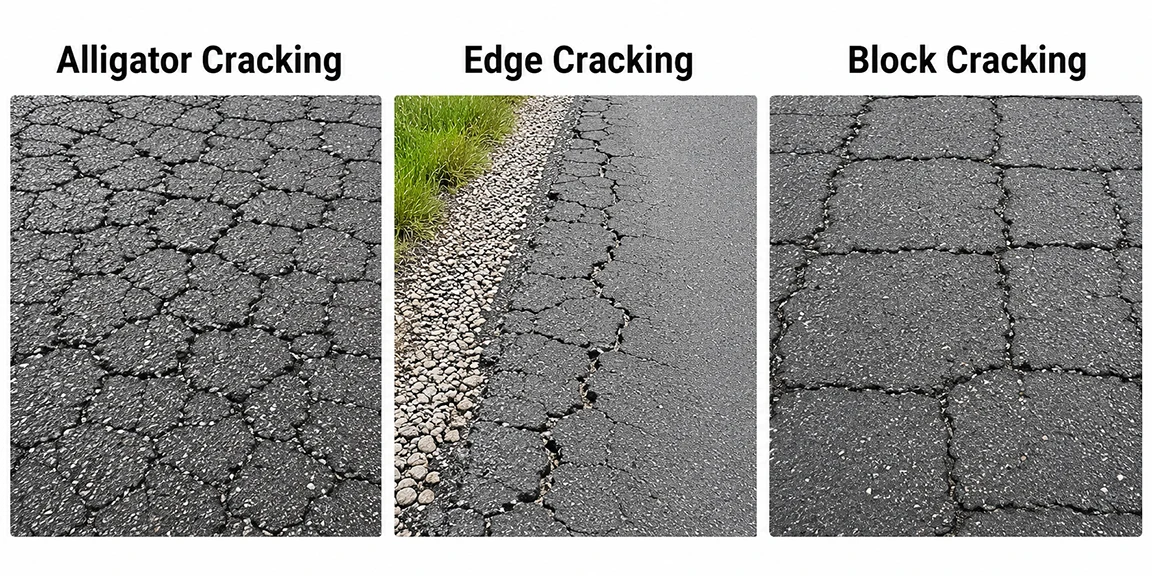
Cracking is the starting point for most asphalt damage, and different crack patterns point to different underlying causes. Recognizing the pattern tells you whether you’re looking at a simple surface fix or a sign of deeper trouble. The four main types of asphalt cracks are alligator, edge, longitudinal and transverse, and block cracking.
Alligator Cracking
Interconnected cracks resembling reptile skin or a chicken-wire pattern. This is the most serious type, signaling that the base beneath the asphalt has failed. Surface sealing won’t fix it — the affected area needs full-depth patching or replacement.
Edge Cracking
Cracks running parallel to and within a foot or two of the pavement’s outer edge. Usually caused by weak shoulder support, poor drainage along the sides, or vehicle weight riding too close to an unsupported edge.
Longitudinal and Transverse Cracking
Straight cracks running parallel to traffic (longitudinal) or across it (transverse). Caused by pavement shrinkage, temperature cycling, or failed seams between paving passes. Sealed early, they stay manageable.
Block Cracking
Large interconnected rectangles across the surface, caused by the asphalt binder aging and shrinking over time. Typically a sign the pavement is entering the back half of its life, though it can often still be sealed.
How Do You Fill and Seal Asphalt Cracks?
Filling cracks as a reactive repair follows a clear sequence. The aim is to clean the crack fully, then fill it with the right material so water can’t get back in. This process handles active cracks up to roughly three-quarters of an inch wide.
- Clean the crack. Remove all dirt, debris, and vegetation from inside the crack using a wire brush, compressed air, or a specialized crack cleaning tool. Filler won’t bond to a dirty crack.
- Dry the surface. Make sure the crack and surrounding area are completely dry. Moisture prevents proper adhesion and shortens the repair’s life.
- Apply the filler. Fill narrow cracks with a pourable crack filler; use rubberized asphalt crack sealer for active cracks that expand and contract. Fill flush with the surface.
- Level and cure. Smooth the filler level with the pavement and let it cure per the product instructions before allowing traffic back over it.
Crack filling is a shorter-term fix that typically lasts one to two years, while professional hot crack sealing with rubberized material can last three to eight years. Sealing cracks on a schedule before damage appears is a core part of asphalt maintenance, which prevents most cracking from becoming a repair in the first place.
How Is a Pothole Repaired?
A durable pothole repair removes the failed material and rebuilds the area properly, rather than just dropping fill into the hole. A full-depth patch is the longest-lasting method, rebuilding the pothole from the base up.
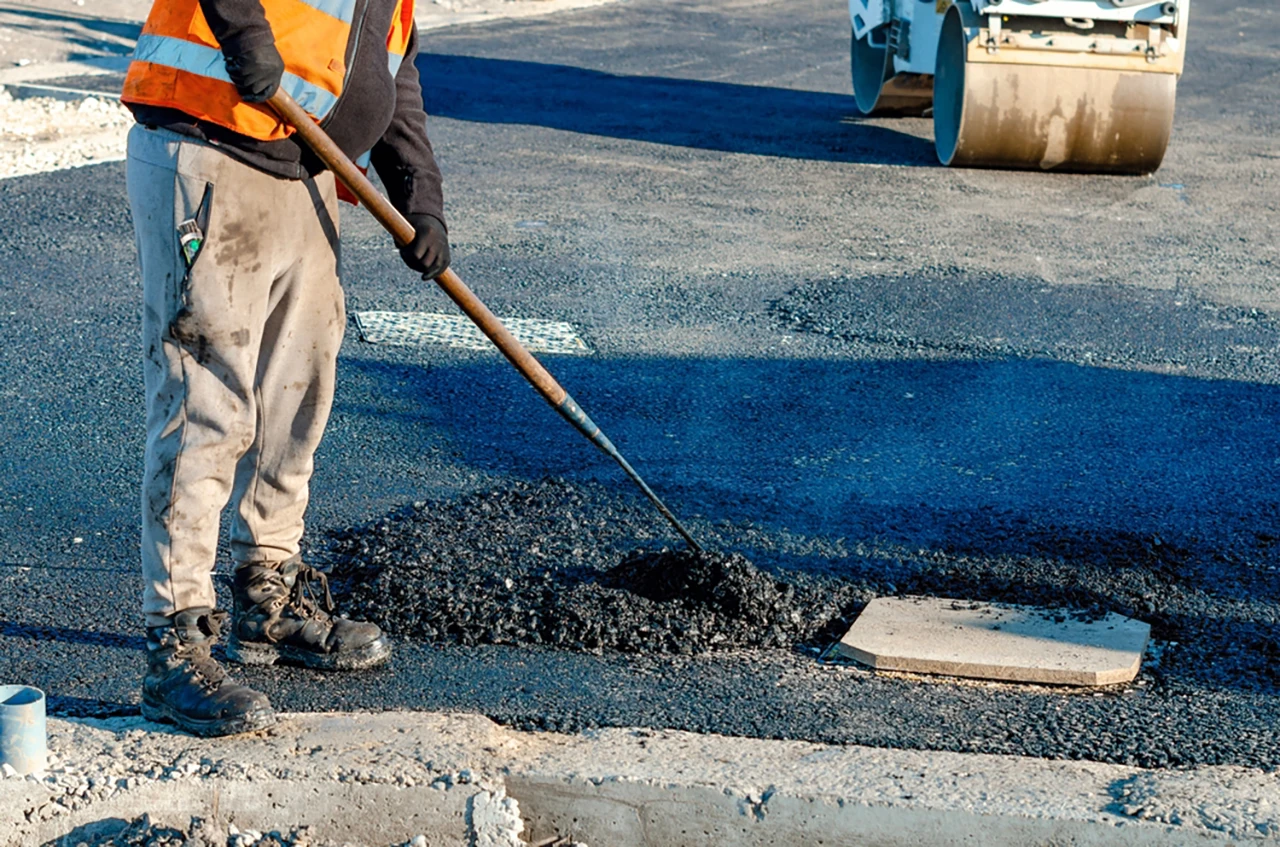
- Cut and square the area. Saw-cut the damaged section into a clean rectangle, cutting back to solid pavement on all sides so the patch has sound edges to bond to.
- Remove debris and failed material. Clear out the broken asphalt, loose aggregate, and any water or mud down to a stable base.
- Apply tack coat. Coat the vertical edges and base with a tack coat so the new asphalt bonds to the surrounding pavement.
- Fill in lifts. Fill the hole with hot mix asphalt in layers (“lifts”) of about two inches, rather than all at once, so each layer compacts fully.
- Compact each layer. Compact every lift with a plate compactor or roller until the patch is dense and sits flush with the surrounding surface.
Cold patch material can be used for a faster, temporary fix, but it doesn’t hold up like a compacted hot mix full-depth patch. Cold patches generally last one to three years; a proper hot mix patch lasts far longer.
Can You Repair Asphalt Yourself?
Some asphalt repairs are reasonable DIY projects; others need professional equipment and expertise to hold up. The dividing line is the severity of the damage and whether the base is involved. Minor surface issues suit a DIY asphalt patch, while structural problems call for a professional.
| Factor | DIY Repair | Professional Repair |
|---|---|---|
| Best for | Hairline cracks, small isolated potholes, minor surface damage | Alligator cracking, large or deep potholes, base failure, drainage issues |
| Materials | Cold patch, pourable crack filler from a hardware store | Hot mix asphalt, rubberized sealant, tack coat, proper compaction equipment |
| Typical lifespan | 1–3 years (temporary) | Several years to permanent, depending on method |
| Cost | Materials only, often under $50 per repair | $100–$250 minimum service fee plus repair cost |
| Main limitation | Can’t address base problems or achieve proper compaction | Higher cost for small jobs |
The honest rule of thumb: a DIY patch is fine as a temporary fix for small, surface-level damage. But if you’re seeing alligator cracking or a pothole keeps coming back after you fill it, the base has failed and no amount of surface patching will hold — that’s a job for a professional.
What Are the Main Asphalt Repair Methods?
Contractors match the repair method to the damage. Minor issues get surface treatments; deeper failures need the pavement rebuilt. The four main asphalt repair methods are crack sealing, patching, overlay, and full-depth repair.
| Method | Best for | How it works | Typical lifespan |
|---|---|---|---|
| Crack sealing | Active cracks up to ¾ inch | Cleans and fills cracks with rubberized sealant to block water | 3–8 years |
| Patching | Potholes and isolated damage | Removes and replaces the failed area with new asphalt | Several years (hot mix) |
| Overlay | Worn but structurally sound surfaces | Adds 1.5–2 inches of new asphalt over the existing pavement | 8–15 years |
| Full-depth repair | Base failure in a specific area | Rebuilds the section down through the base and repaves | Long-term |
Overlay sits on the line between repair and replacement — it refreshes a tired surface without a full rebuild, but only works when the base is still sound. When damage runs deeper than the surface, an overlay just postpones the inevitable. We cover that trade-off in depth in our guide to asphalt overlay versus full replacement.
How Much Does Asphalt Repair Cost?
Asphalt repair cost depends on the method, the size of the damage, and the extent of the underlying problem. Most repairs also carry a minimum service fee of $100 to $250 that covers the contractor’s call-out. Professional pricing runs from about $0.50 per linear foot for crack sealing up to $8 per square foot for full-depth repair, depending on the type of work.
| Repair type | Typical cost |
|---|---|
| Crack filling / sealing | $0.50–$3.00 per linear foot |
| Pothole repair | $100–$400 per pothole |
| Hot-patch repair | $2–$5 per square foot |
| Overlay / resurfacing | $2–$4 per square foot |
| Full-depth repair | $4–$8 per square foot |
| Minimum service fee | $100–$250 |
To put those figures in context: filling the cracks on a typical driveway usually runs $100 to $400, a single pothole patch $100 to $400, and a full resurfacing $2 to $4 per square foot. Repair almost always costs a fraction of the $4 to $7 per square foot of full replacement — which is exactly why addressing damage early pays off. Costs run somewhat higher on the West Coast, including the Sacramento region, than the national average.
Should You Repair or Replace Your Asphalt?
The choice between repairing and replacing asphalt comes down to how much of the surface is damaged, the condition of the base, and the age of the pavement. Repair makes sense when the damage is contained and the foundation is sound; replacement makes sense when the base has failed or damage is widespread.
Repair is usually the right call when:
- Damage covers less than about 25% of the surface
- Problems are limited to cracks, isolated potholes, or minor surface wear
- The base underneath is still solid
- The pavement is within its expected lifespan
Replacement is usually the right call when:
- Widespread alligator cracking shows the base has failed
- Damage covers a large share of the surface
- Repairs keep recurring in the same areas
- The pavement is well past its expected lifespan
- Drainage failures are undermining the pavement from below
The clearest signal is repeat failure. If you patch a pothole and it returns, or you seal cracks and new ones open nearby, the problem is beneath the surface — and surface repairs can’t fix a failed base.
When Repair Isn’t Enough
Repair is the right answer for most asphalt problems, but there’s a point where continuing to patch and seal becomes throwing good money after bad. When the base has failed, when damage is widespread, or when the pavement is simply worn out, asphalt replacement becomes the more cost-effective long-term choice — worth understanding before sinking more money into a surface that’s past saving.
Repair Your Asphalt the Right Way
Whether it’s a few cracks, a stubborn pothole, or damage that has you weighing repair against replacement, the right fix starts with an honest assessment of what’s happening beneath the surface. Noble Cortes General Engineering repairs asphalt for residential, commercial, and public clients across El Dorado, Sacramento, Placer, and Amador counties. Contact us today for a free quote on your asphalt repair project.
