
Asphalt driveways are one of the most popular driveway choices across Northern California, and for good reason. They’re affordable, durable, relatively easy to maintain, and they look sharp when freshly installed.
But like any major home investment, an asphalt driveway pays off best when the homeowner understands what they’re getting into — the upfront cost, the realistic lifespan in our climate, and what it takes to keep one in shape over the long haul.
What is an Asphalt Driveway?
An asphalt driveway is a paved residential surface made from a mix of crushed stone, sand, gravel, and bitumen — a petroleum-based binder that holds everything together. The mixture is laid down hot, compacted with rollers, and allowed to cool into a dense, flexible surface that handles vehicle traffic and weather well.
Most residential asphalt driveways consist of 2 to 3 inches of asphalt over a compacted aggregate base of 4 to 8 inches. The thicker the base and the better the drainage, the longer the driveway will hold up.
Asphalt Driveway Cost
Asphalt driveway cost depends on the size of the driveway, the condition of the existing surface or ground, the thickness of the asphalt being installed, and any prep work needed before paving.
In the Sacramento area and surrounding foothills, asphalt driveway installation typically runs $5 to $9 per square foot, putting most residential projects in the $4,500 to $8,000 range for a standard two-car driveway. Larger or more complex jobs — long rural driveways, steep foothill grades, removal of existing pavement — can push that figure into the $10,000+ range.
Recurring costs are a smaller piece of the picture but worth budgeting for. Sealcoating runs roughly $0.25 to $0.40 per square foot every 2 to 3 years. Minor crack and pothole repairs usually run a few hundred dollars or less. Resurfacing with a 2-inch overlay after 10 to 15 years runs around $2 to $4 per square foot — roughly half of new installation. Full replacement after 20 to 25 years tracks closely with new installation pricing.
How Long Does an Asphalt Driveway Last?
In the Sacramento Valley and the El Dorado, Placer, and Amador foothills, a properly installed asphalt driveway typically lasts 15 to 25 years, with well-maintained driveways often pushing past 25. Driveways that get neglected — no sealing, ignored cracks, poor drainage — can fail in 10 years or less.
Our climate is actually kinder to asphalt than colder, snowier parts of the country. Valley areas don’t see the dramatic freeze-thaw cycles that punish asphalt back east, which means less of the deep cracking that shortens driveway lifespan in those regions. The trade-off is the long, hot dry season. Months of triple-digit summer temperatures plus intense UV soften asphalt, accelerate oxidation, and fade the surface faster than mild-climate areas.
A few factors still determine where a specific driveway lands on the 15-to-25-year range:
- Quality of installation. A driveway laid over a properly prepared base on graded soil with good drainage will outlast one that was rushed at any stage.
- Elevation and exposure. Higher-elevation foothill driveways (Placerville, Auburn, and above) see more freeze-thaw than valley driveways. South-facing driveways with no shade take heavier UV punishment year-round.
- Traffic load. A driveway hosting a few personal vehicles holds up longer than one parking heavy delivery trucks or RVs night after night.
- Maintenance discipline. Consistent sealing and prompt crack repair can easily double the practical lifespan of a driveway.
The bigger takeaway: how long an asphalt driveway lasts in our region has less to do with the asphalt itself than with how the base was prepared and how diligently the surface is maintained against summer heat and UV exposure.
Concrete vs. Asphalt Driveway
The concrete vs. asphalt driveway decision comes down to four main factors: upfront cost, lifespan, climate fit, and aesthetics.
Cost. Asphalt is generally 30 to 50 percent cheaper upfront than concrete. For a typical residential driveway, that’s a few thousand dollars in savings at installation.
Lifespan. Concrete lasts longer on paper — 30 to 40 years versus 15 to 25 for asphalt in our region — but maintenance habits matter more than the headline number. A neglected concrete driveway can fail in 15 years; a well-maintained asphalt one can comfortably reach 30.
Climate. In colder regions, asphalt’s flexibility gives it an edge over concrete because it absorbs freeze-thaw movement without cracking. In the Sacramento area and surrounding foothills, that advantage is muted — we don’t get the severe freezing that punishes concrete elsewhere. The local climate concern actually runs the other direction: hot summer surface temperatures soften asphalt, while concrete stays dimensionally stable.
Aesthetics. Concrete offers more design flexibility — stamping, staining, exposed aggregate finishes. Asphalt offers the classic clean black look that suits most homes without trying too hard.
For homeowners in our service area, the choice typically comes down to upfront budget and aesthetic preference more than climate compatibility. Both materials perform well here when properly installed and maintained.
Asphalt Driveway Maintenance
Asphalt driveway maintenance isn’t complicated, but it does have to be consistent — especially given the heat and UV exposure typical of our region. The pavement’s worst enemies are sunlight, water, and petroleum products, and the basic maintenance routine addresses all three.
The standard care schedule looks like:
- Sealcoat every 2 to 3 years to protect against UV exposure, water infiltration, and oil contact (NorCal driveways generally need sealing more often than the national 3-to-4-year recommendation because of the sustained summer heat and UV)
- Fill cracks promptly before water gets underneath and undermines the base
- Clean oil and gas spills quickly, since petroleum products dissolve the binder in asphalt
- Keep heavy vehicles off the edges, where the pavement is structurally weakest
Beyond the standard routine, paying attention to drainage is the most overlooked aspect of asphalt driveway maintenance. Gutters that empty onto the driveway, downspouts pointed the wrong direction, and low spots that pool water during the wet season all shorten lifespan dramatically. Most premature driveway failures around here trace back to water sitting where it shouldn’t during the winter rains.
Asphalt Driveway Sealer
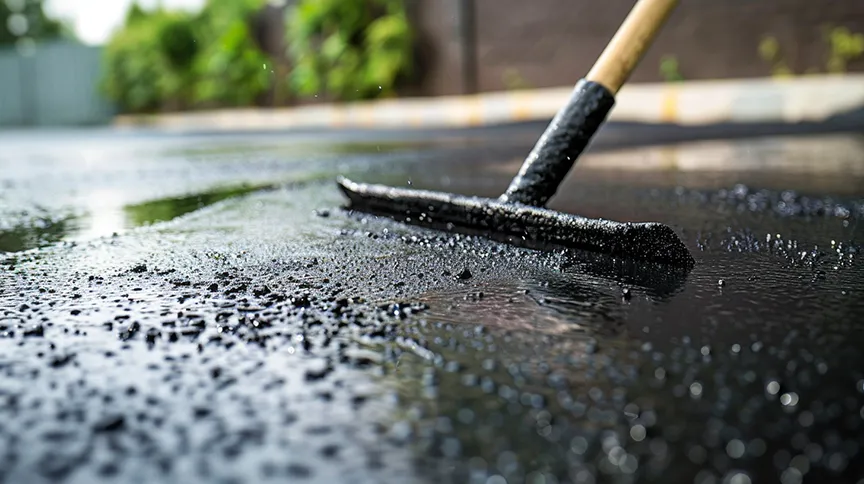
Asphalt driveway sealer is a liquid coating applied to the pavement surface to protect it from UV rays, water infiltration, oil and chemical spills, and general weathering. It also restores that deep black appearance that fades as asphalt ages.
Two main types are commonly used on residential driveways:
Coal tar emulsion sealers are the traditional standard. They offer excellent chemical resistance and a rich black finish, but they’ve come under environmental scrutiny in recent years and are banned or restricted in some jurisdictions.
Asphalt emulsion sealers are the more environmentally friendly alternative. They’re easier to clean up, lower in VOCs, and approved everywhere, though they generally don’t last quite as long between applications as coal tar versions.
Professional applications typically deliver the best results, but DIY sealing kits are widely available. Either way, the key variables are surface cleanliness, weather conditions during application, and adequate cure time before vehicle traffic returns. Late spring through early fall — dry, warm but not blistering — is generally the best sealing window in our area.
Asphalt Driveway Cracking
All asphalt driveways crack eventually. The real question is whether the cracking is cosmetic, manageable, or a sign of bigger problems underneath. Most asphalt driveway cracking falls into a few recognizable categories.
Hairline cracks are thin, shallow surface cracks caused by normal aging and weathering. They’re easy to seal and rarely a structural concern on their own.
Block cracks form interconnected rectangular patterns and usually indicate the asphalt has aged and shrunk over time. They can typically be sealed but may signal that the driveway is approaching the back half of its useful life.
Edge cracks run parallel to the edges of the driveway. They’re usually caused by weak shoulder support, poor drainage along the sides, or vehicle weight too close to the edge.
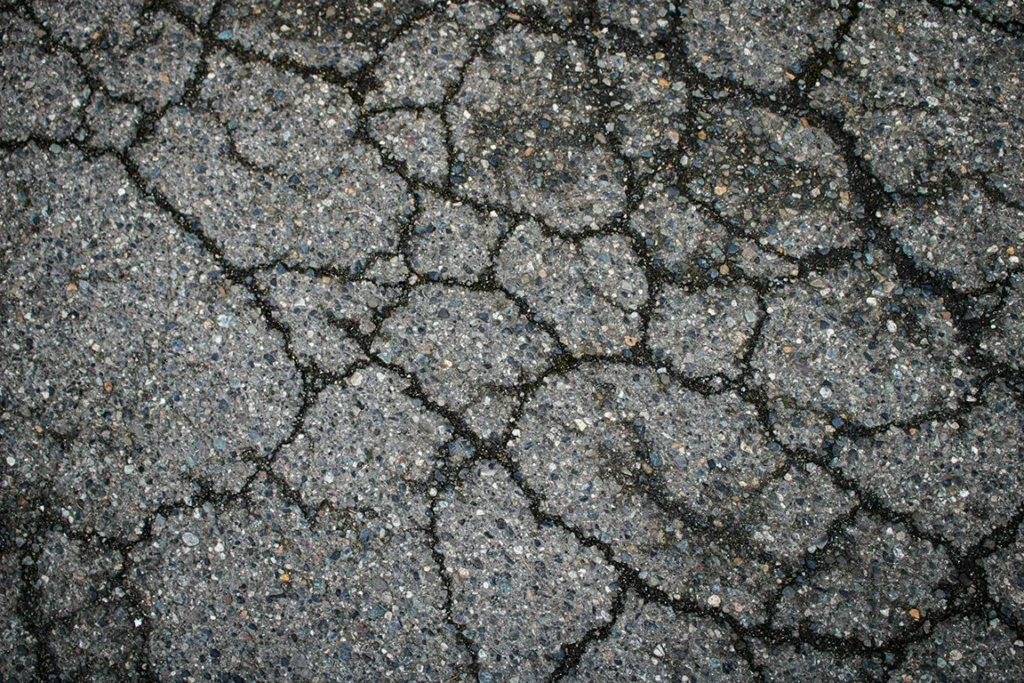
Alligator cracking is the most serious. It looks like interconnected reptile-skin patterns and signals that the base beneath the asphalt is failing. Sealing alone won’t fix it — the affected area typically needs full-depth patching or replacement. In our region, alligator cracking often shows up in driveways that have taken years of summer heat without sealing, or in spots where winter water has been sitting too long.
Catching cracking early and sealing it before water reaches the base is the single most effective thing a homeowner can do to extend driveway lifespan. Once water gets underneath, the clock starts ticking.
Repair or Replace an Asphalt Driveway?
The decision to repair or replace an asphalt driveway comes down to three things: the extent of the damage, the age of the existing pavement, and the cost of repairs relative to full replacement.
Repair tends to be the right call when:
- The driveway is under 15 years old
- Damage is limited to surface-level cracks and isolated potholes
- The underlying base appears structurally sound
- Total repair cost runs well under half of replacement cost
Replacement tends to be the right call when:
- The driveway is past 20 years old
- Alligator cracking covers significant areas
- Multiple drainage problems exist alongside surface damage
- Repair costs are approaching half or more of replacement cost
There’s also a middle path: resurfacing. Resurfacing places a fresh layer of asphalt over an existing driveway that’s structurally sound but cosmetically worn. It’s significantly cheaper than full replacement and can buy another 10 to 15 years of useful life on the right surface.
When the underlying base has failed, though, no surface treatment will save the driveway. Full replacement is the only way forward.
Working With the Right Asphalt Driveway Contractor
A well-installed and properly maintained asphalt driveway can serve a home for 20 to 30 years with relatively modest care. The two factors that make the biggest difference are the quality of the original installation and the consistency of the maintenance afterward.
Noble Cortes General Engineering installs, maintains, and repairs asphalt driveways across El Dorado, Sacramento, Placer, and Amador counties. Contact us today for a free quote on your asphalt driveway project.
