
Asphalt parking lots are the backbone of nearly every commercial property, municipal facility, church, and shopping center in Northern California. They shape first impressions, direct traffic flow, and represent a real capital investment for the properties they serve.
But most owners and facility managers only think seriously about their parking lot when something goes wrong — a customer trips on a pothole, drainage fails during a winter storm, or the striping fades to the point where cars are parking wherever they please. A well-planned and consistently maintained asphalt parking lot pays off across decades. Get the fundamentals right and it becomes a durable, low-drama asset.
What is an Asphalt Parking Lot?
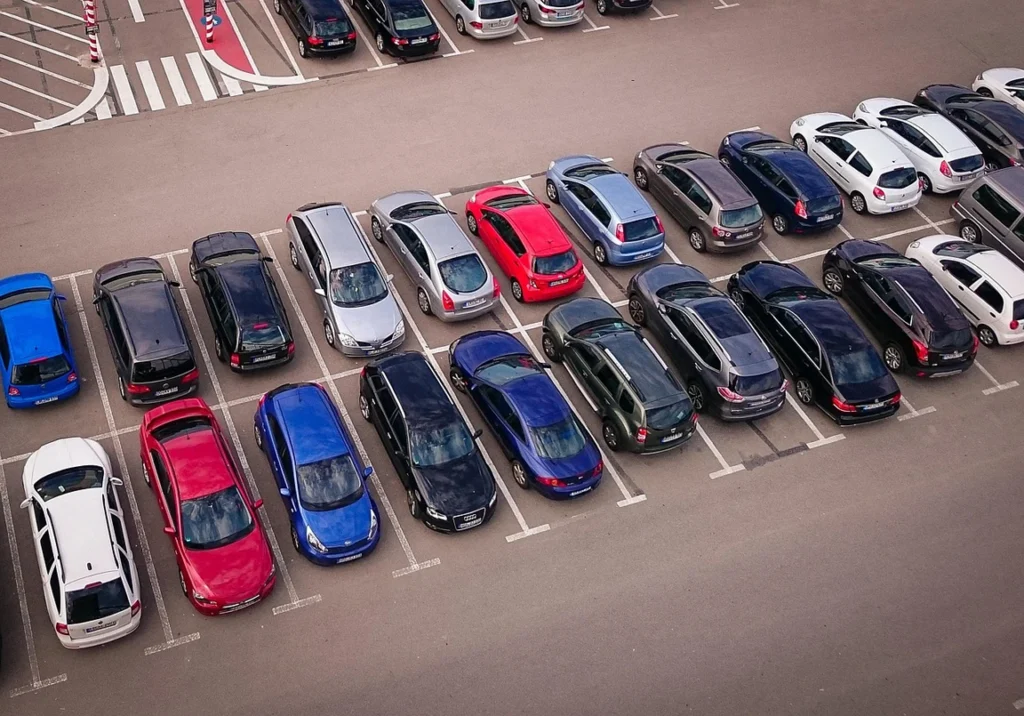
An asphalt parking lot is a paved commercial or public surface designed to handle vehicle traffic, parking, and pedestrian access over a large footprint. It shares the same basic construction as any other asphalt surface — hot mix asphalt over a compacted aggregate base — but the engineering specifications are heavier than what goes under a residential driveway.
A typical commercial parking lot uses 3 to 4 inches of asphalt over 6 to 10 inches of aggregate base, with the exact thickness dictated by the traffic load the lot will carry. Standard passenger vehicle lots sit on the lighter end. Lots that handle delivery trucks, buses, or heavy equipment need thicker pavement and a deeper base.
The engineering demands go beyond just thickness. Slope, drainage, striping, ADA compliance, and traffic flow all factor into how a parking lot is designed and built. A parking lot that ignores any of these tends to reveal the shortcut sooner than later.
Asphalt Parking Lot Cost
Asphalt parking lot cost varies more than most people expect. The size of the lot, the thickness of the pavement, the condition of the site before work begins, and whether existing pavement needs removal all move the number meaningfully.
For a new asphalt parking lot in the Sacramento area, expect installation to run $3 to $7 per square foot for standard commercial specifications. Heavy-duty lots with thicker pavement, extensive site preparation, or complex drainage requirements can push $8 to $10+ per square foot. A small commercial lot around 10,000 square feet typically runs $30,000 to $70,000 installed. A mid-size lot at 30,000 square feet lands in the $90,000 to $210,000 range. Larger lots at 100,000+ square feet clear $300,000 easily and scale from there based on size and complexity.
Beyond installation, budgeting for the lot’s lifecycle matters. Sealcoating runs $0.20 to $0.35 per square foot every 2 to 3 years in our region. Restriping is a periodic expense that varies with lot size and paint type. Resurfacing every 15 to 20 years runs $2 to $5 per square foot. Skipping the recurring costs to save money short-term almost always shortens the lot’s overall lifespan and increases lifetime cost.
How Long Does an Asphalt Parking Lot Last?
A well-installed asphalt parking lot in the Sacramento Valley and surrounding foothills typically lasts 15 to 25 years before major intervention is needed, with well-maintained lots often stretching past that. Lots that get neglected — no sealcoating, ignored cracks, drainage issues left to compound — can start failing at the 8 to 10 year mark.
Our regional climate is generally favorable for asphalt parking lot lifespan, but not without its challenges. The valley’s mild winters and limited freeze-thaw mean less of the seasonal cracking that shortens pavement life in colder climates. The trade-off is the punishing summer heat and UV exposure, which soften asphalt, accelerate oxidation, and speed up surface deterioration.
For commercial lots specifically, traffic patterns matter as much as climate. A lot serving a professional office with predictable daytime parking will outlast one hosting a busy restaurant with constant vehicle turnover, delivery truck traffic, and vehicles idling in the same drop-off spots.
Four things drive where a specific lot lands on the 15-to-25-year range. Installation quality matters most — cutting corners at the base stage causes premature failure regardless of what happens above. Drainage design is nearly as important, since water sitting on the surface or infiltrating the base is the fastest way to reduce pavement life. Traffic volume and vehicle weight determine how quickly the surface wears, with heavier vehicles concentrating load and accelerating rutting. And maintenance consistency — regular sealcoating and prompt crack repair — can extend usable life by 10+ years on its own.
Asphalt vs. Concrete Parking Lot
The asphalt vs. concrete parking lot decision breaks down along four main lines: upfront cost, lifespan, climate performance, and maintenance profile.
Cost. Asphalt runs about 30 to 50 percent cheaper upfront than concrete for equivalent square footage. On a mid-size commercial lot, that’s often tens of thousands of dollars in savings at installation.
Lifespan. Concrete parking lots can last 30 to 40 years versus 15 to 25 for asphalt. But that headline number depends heavily on maintenance discipline — a well-maintained asphalt lot can push into concrete territory, while a neglected concrete lot can fail early.
Climate. In cold-region parking lots, asphalt’s flex advantage matters because it absorbs freeze-thaw without cracking. In the Sacramento area, that advantage is muted since severe freeze-thaw isn’t really a factor. What matters more here is heat: sustained summer temperatures soften asphalt, while concrete stays dimensionally stable.
Maintenance. Asphalt maintenance is more frequent (sealcoating every 2 to 3 years) but easier to plan and less disruptive. Concrete maintenance is less frequent, but repairs are harder to blend visually when damage does occur.
For most commercial and municipal property owners in our region, the calculus comes down to budget, expected use, and how quickly the lot needs to be operational. Asphalt installs faster, costs less upfront, and makes financial sense for most standard applications. Concrete makes more sense for lots that will handle sustained heavy loads or where 30-year replacement cycles are preferred over 20-year cycles.
Asphalt Parking Lot Maintenance
Asphalt parking lot maintenance is a long-term game. Individual maintenance actions look small — a few thousand dollars for sealcoating, a few hundred for crack filling — but stacked together over the lot’s life, they represent the difference between a 25-year lot and a 12-year one.
The standard commercial maintenance schedule includes:
- Sealcoating every 2 to 3 years to protect against UV, water, and chemical damage
- Crack filling as soon as cracks appear, before water gets underneath and undermines the base
- Prompt cleaning of oil, gas, and chemical spills, which break down bitumen on contact
- Annual visual inspections, with semi-annual professional inspections for larger lots
- Restriping as needed to maintain visibility of parking spaces, aisles, and ADA markings
Drainage is the maintenance issue most often ignored until it becomes expensive. Standing water anywhere on a parking lot — around drains that have partially failed, in low spots that developed after settling, or against curbs where debris blocks flow — quietly shortens the pavement’s life. Adding drainage inspections to the maintenance rotation prevents small drainage problems from turning into structural pavement failures.
How Often to Sealcoat a Parking Lot
The general rule for how often to sealcoat a parking lot is every 2 to 3 years, but the actual right frequency depends on traffic volume, sun exposure, and the lot’s current condition. In Northern California, the shorter end of that range (closer to 2 years) is often the better call because of how hard summer UV works on asphalt surfaces.
Some situations call for even more frequent sealcoating. Lots with heavy traffic or high vehicle turnover wear their surfaces faster. Lots with significant direct sun exposure and no shade oxidize sooner. Lots showing early signs of graying or oxidation need attention before the damage progresses. And lots that experienced heavy chemical or oil exposure during the last cycle may need touch-up sealing sooner than the calendar suggests.
Timing within the year matters too. Late spring through early fall — dry, warm, but not blistering — is generally the best sealcoating window in our region. Applications made too close to summer’s peak heat cure unevenly. Applications made once the wet season starts don’t cure properly at all.
A first sealcoat should typically wait 6 to 12 months after new asphalt installation to allow the oils in fresh pavement to fully cure. Sealing too early can cause adhesion problems and shorten the life of the sealer itself.
Parking Lot Striping
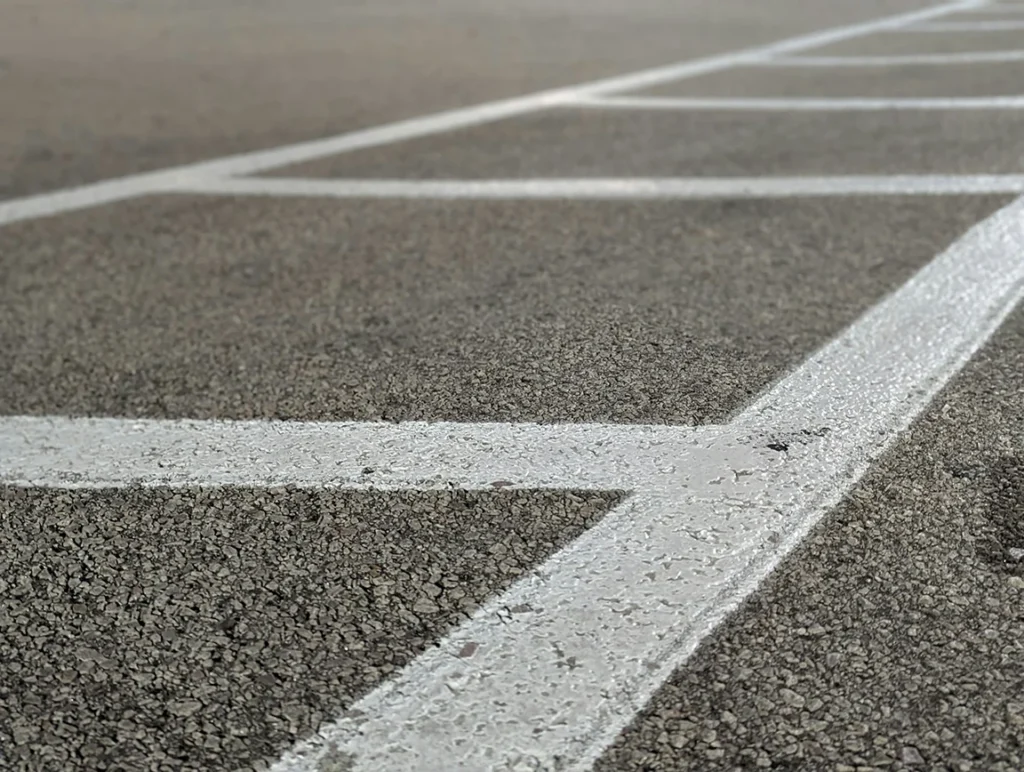
Parking lot striping is the visual system that tells drivers where to park, where to drive, where not to stop, and where accessible spaces are located. It’s also the layer of the parking lot that fades fastest, since it’s exposed to constant tire contact, UV, and weather.
The industry-standard passenger vehicle stall in most California jurisdictions is 9 feet wide by 18 feet long, though dimensions can vary based on local code and lot layout. Beyond the stalls themselves, striping typically includes:
- Directional arrows and drive aisle markings for traffic flow
- ADA-required accessible space and access aisle markings
- Fire lane markings — red curb with “NO PARKING FIRE LANE” text
- No-parking zones marked with cross-hatched patterns
- Curb painting for accessibility and directional guidance
Two main paint types get used on parking lots. Water-based latex paint is more affordable and dries fast but wears down within 1 to 3 years depending on traffic. Thermoplastic striping costs more upfront but lasts 4 to 8 years and holds up better against high-traffic wear. Most standard commercial lots use latex; high-traffic lots and public facilities often benefit from thermoplastic.
Restriping is usually needed every 1 to 3 years to maintain visibility and safety. Lots with faded striping create real liability exposure — drivers unclear where to park, ADA compliance issues, and emergency access confusion.
Parking Lot Crack Repair
Parking lot crack repair is one of the highest-return maintenance activities a property owner can undertake. A small crack sealed this year is a $50 fix. The same crack left for three winters, with water infiltrating the base each rainy season, becomes a $2,000 patch or a $10,000+ resurfacing project.
The most common crack types in commercial parking lots each call for different responses.
Hairline cracks are thin surface cracks caused by normal aging and weathering. Simple crack sealing handles these effectively.
Longitudinal and transverse cracks run parallel or perpendicular to the direction of traffic. They’re usually caused by pavement contraction, joint failures, or base movement. Sealing works if caught early.
Block cracks form interconnected rectangular patterns and indicate the asphalt has aged and shrunk over time. They can be sealed, but they often signal the lot is entering the back half of its useful life.
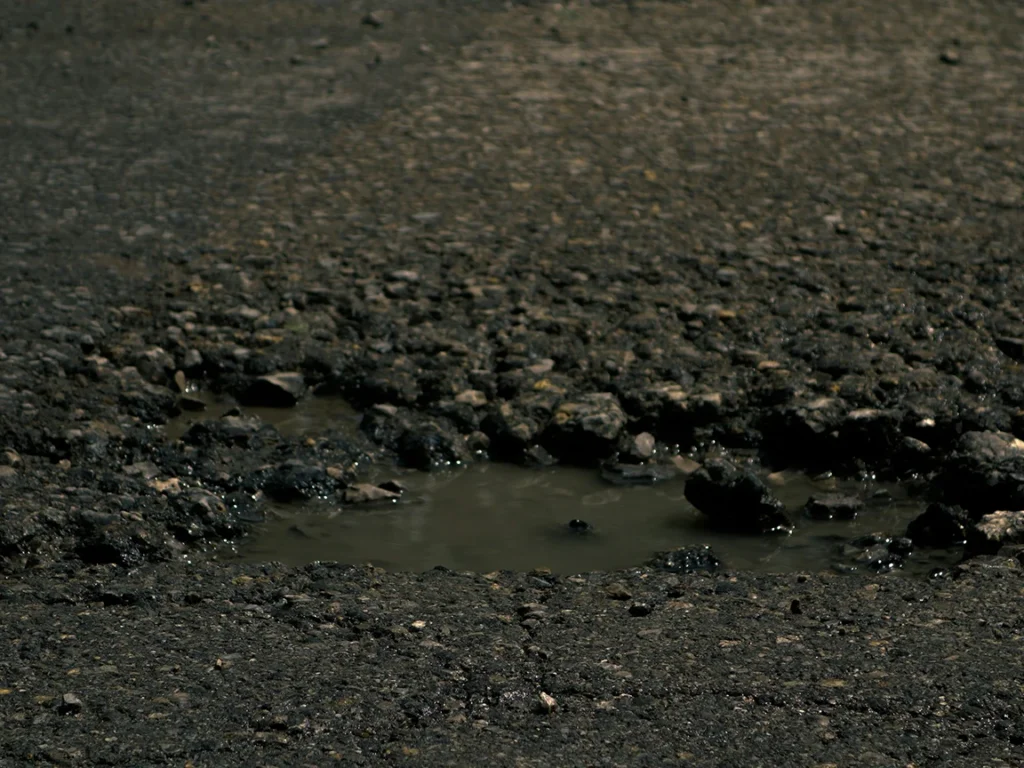
Alligator cracking — interconnected reptile-skin patterns — signals the base beneath the asphalt is failing. Sealing alone won’t fix it. The affected area needs full-depth patching or removal and replacement.
Effective crack repair depends on catching problems early and matching the method to the damage. Rubberized crack sealant works well for most active cracks under a half-inch wide. Wider cracks and structural failures need cold patch, hot mix patching, or full-depth reconstruction depending on severity.
Parking Lot Resurfacing Signs
Resurfacing (also called an overlay) places a fresh 1.5 to 2-inch layer of asphalt over an existing lot that’s structurally sound but cosmetically worn. It’s significantly cheaper than full replacement and can extend the usable life of a parking lot by another 10 to 15 years.
Several parking lot resurfacing signs indicate a lot is ready for an overlay rather than continued patching. Multiple isolated cracks and small patches becoming hard to keep up with often mean the lot has moved past routine repair territory. Surface oxidation and fading that sealcoating no longer masks is another common indicator. Rutting or minor depressions in traffic lanes suggest the wear layer needs refreshing. If the lot is 10 to 15 years past its last major resurfacing and ongoing repair costs are climbing, an overlay is likely the next logical step — assuming the underlying base is still sound.
Resurfacing has limits. If the base has failed — evidenced by widespread alligator cracking, drainage failures, or significant structural cracking throughout — an overlay won’t solve the underlying problem. It’ll just delay the inevitable full replacement while adding cost. A good contractor will assess the base and be straightforward about whether resurfacing will actually pay off.
ADA Parking Lot Compliance
ADA parking lot compliance isn’t optional for commercial and public parking lots — it’s federal law under the Americans with Disabilities Act. Non-compliance creates real liability exposure, from ADA lawsuits to penalties during inspections.
The main requirements center on the number, size, and placement of accessible parking spaces:
- Minimum number of accessible spaces is based on the total number of parking spaces in the lot (roughly 4% of standard spaces, scaling with lot size)
- At least one in every six accessible spaces must be van-accessible with a wider access aisle
- Location matters — accessible spaces must be on the shortest accessible route to the building entrance
- Access aisle width must be 5 feet for standard accessible spaces and 8 feet for van-accessible spaces
- Slope requirements — the parking space and access aisle surface cannot exceed a slope of 1:48 (about 2%) in any direction
Signage requirements apply on top of the space and dimension rules. Each accessible space needs a proper sign mounted at least 60 inches above the ground, displaying the international symbol of accessibility. Van-accessible spaces need additional signage identifying them as such.
The rules apply to new construction and, importantly, to resurfacing and restriping projects. Any time a lot is being redone, current ADA requirements apply — not the requirements in place when the lot was originally built. Many older lots built compliant with earlier codes fall out of compliance the moment a resurfacing project happens, which catches property owners off guard regularly.
For lots serving state, county, or municipal facilities, additional California-specific accessibility requirements layer on top of the federal ADA baseline. A contractor familiar with both federal ADA and California standards is essential for any public works parking lot project.
Working With the Right Asphalt Parking Lot Contractor
A well-planned and consistently maintained asphalt parking lot serves a property for 20 to 30 years while protecting visitors, supporting daily operations, and reflecting well on the business or agency that owns it. Getting there requires attention at every stage — installation, drainage, striping, ongoing maintenance, and timing decisions on when to repair, resurface, or replace.
Noble Cortes General Engineering installs, maintains, and repairs asphalt parking lots for commercial properties, municipalities, schools, churches, and public agencies across El Dorado, Sacramento, Placer, and Amador counties. Contact us today for a free quote on your asphalt parking lot project.
